Full scaffolds exceed text-only scores on abstract false-belief tasks and MuMA-ToM. On MindPower, they improve scores but remain below text-only input. Automatic descriptions produce smaller gains or lower scores.

Vision-language models pass text-based false-belief probes at near-human levels but drop by twenty or more percentage points the moment the same problem is conveyed visually. The consensus diagnosis is conceptual, prescribing new belief-reasoning modules. We argue the bottleneck is perceptual: not what the model cannot reason about, but what it cannot see. We propose a five-condition dissociation protocol that holds the reasoning task constant while varying perceptual fidelity from visual only to text only, and quantify the result with the Perceptual Contribution Ratio, a dose-response metric measuring how much of the visual-to-text gap a scaffold of given fidelity closes. Instantiated on abstract 2D panels in the Heider-Simmel tradition and naturalistic 3D game scenes from MuMA-ToM and MindPower across seven VLMs and roughly 147,000 API calls, ground-truth scaffolds close the gap on every regime, matching or exceeding the text-only ceiling on abstract panels and MuMA-ToM. Automatic parsers, including frontier VLMs as zero-shot scene describers, fail. The dominant visual-only error mode is reality bias (60% of false-belief failures): models report where an object currently is rather than where an absent agent believes it to be, the signature of a front-end that fails to encode who was present when. The route to better visual social reasoning runs through perception, not new reasoning modules.
Full scaffolds exceed text-only scores on abstract false-belief tasks and MuMA-ToM. On MindPower, they improve scores but remain below text-only input. Automatic descriptions produce smaller gains or lower scores.
| Setting | A | Ba | Bp | Bf | C |
|---|---|---|---|---|---|
| MuMA-ToM | 44.7 | 47.4 | Not defined | 58.1 | 54.0 |
| MindPower | 19.1 | 18.3 | 24.1 | 27.3 | 33.0 |
| Abstract false belief | 73.9 | 75.7 | 88.8 | 98.4 | 94.5 |
MindPower’s Bf includes the reference reasoning chain. Bp uses perceptual information and raises the mean score from 19.1 to 24.1.
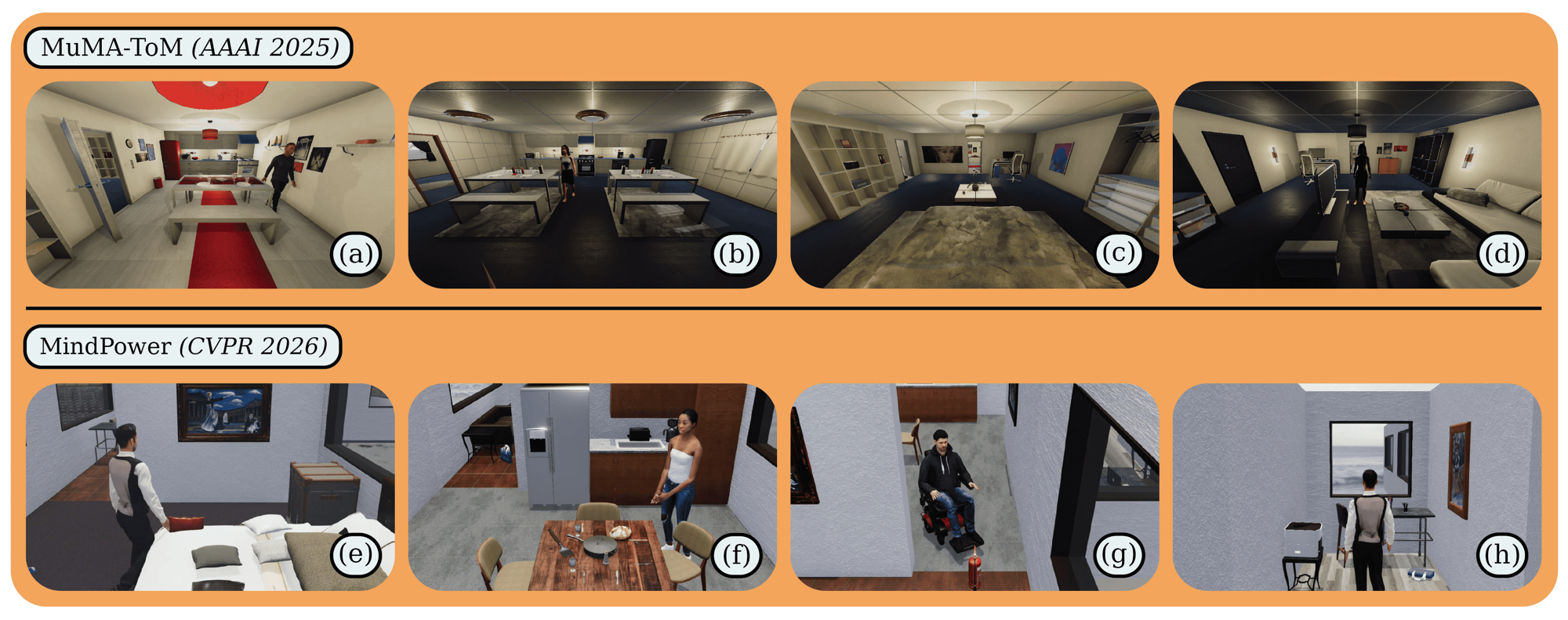
MuMA-ToM contains household videos. MindPower contains embodied scenarios in ThreeDWorld and VirtualHome.
@inproceedings{barhdadi2026perception,
  title     = {Perception, Not Reasoning, Limits Visual Theory of Mind},
  author    = {Barhdadi, Mohamed Rayan and Wasim, Syed Talal and Gall, Juergen
               and Serpedin, Erchin and Kurban, Hasan},
  booktitle = {Advances in Neural Information Processing Systems},
  year      = {2026}
}